
August 21, 2015
Great cultures
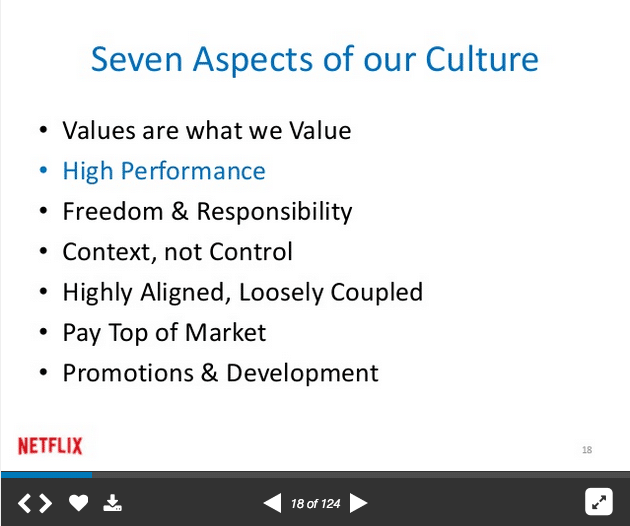
When we experience abundance, we want to share. Bill Gates, the richest person in the world, started the largest foundation in the world.
But sharing isn’t just about money. For companies, it’s about sharing what we’ve learned, and the most successful and innovative companies know it.
Netflix shares its culture deck and its evolving policies. Disney Institute offers classes in how it dazzles its customers, as does Ritz Carlton. And of course Zappos Insights (the Zappos.com company I co-created), offers entire experiences in culture.
But the great thing is, you don’t have to be big and famous to do this. Anyone can create a culture book, like the culture book of 360incentives.com.
And it doesn’t have to be a production either. It can be a blog, a podcast, a tour, a whitepaper. Just share what you learn and what you care about. It will help you grow and scale your culture.
August 5, 2015
Great cultures

I had the honor of podcasting with Mark McKergow, author of Host. This is the most compelling leadership philosophy I’ve heard. It completely aligns withe culture of the network age. You can listen to the whole podcast here.
August 3, 2015
Great cultures

There’s a certain irony to giving speeches and writing books as a “culture expert” because culture must be experienced to believe it.
Robert James Waller said it best when he was talking about romance…
I looked up the definition of romance in several dictionaries. As I guessed, reading the definitions of romance is about the most unromantic thing you can do…
Romance you see, is something that you take care of – romance needs food and water and care, of a kind all her own. You can destroy romance, or ate least drive her away without knowing that you are doing it.
Romance dances just beyond the firelight, in the corner of your eye. She does not like you to look at her directly, she flees from the cold light of logic and data collection when it is turned toward her. If you persist in trying to study her, however, she first disintegrates, then dissolves into nothing at all.
E.B. White once said a similar thing about humor which, ‘can be dissected, as a frog, but the thing dies in the process and the innards are discouraging to any but the pure scientific mind.’ You can’t get at romance, then, by good old Western reductionism.
That’s why for each of my topics (culture hacking, innovation and values-driven culture), I like to create an experience for people. It’s what really lasts, and it’s the most powerful way to shift beliefs without ever preaching.
July 6, 2015
Hacks ,Personal Exploration ,Vision
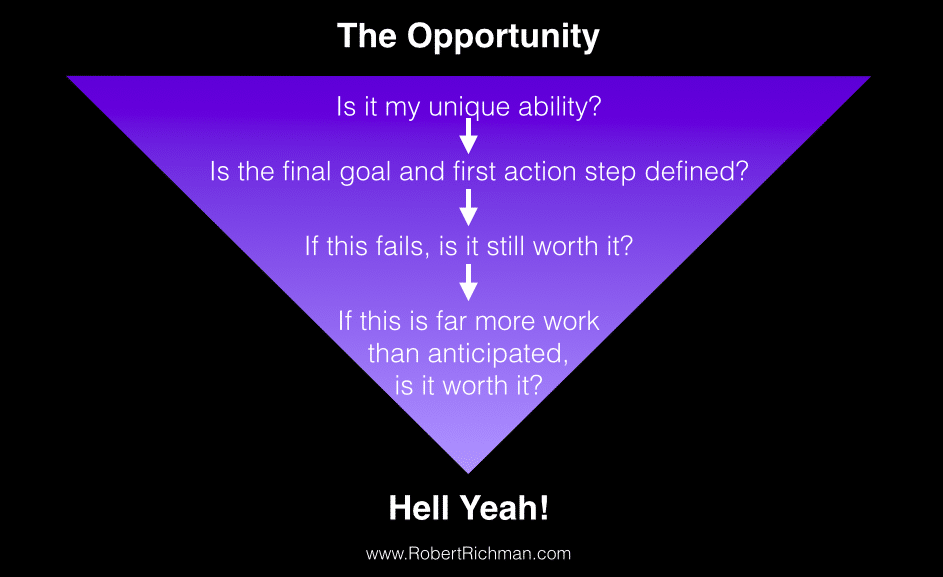
“It’s either a Hell Yeah, or it’s a No.” – Derek Sivers.
I’ve found this quote to be a great decision making tool. We have so many choices of how to spend our time, money and energy. So why do anything less than a “Hell Yeah!”?
Not only can it be hard to say No to things. It’s not always easy to evaluate an opportunity and understand if it’s really a Hell Yeah.
So here is a decision-making framework I developed.
It starts with, is this my unique ability? (a concept pioneered by Dan Sullivan of Strategic Coach). A unique ability is a talent that you have passion and skills for, there is a need for it, and most importantly, you feel it gives you energy.
Next, I’ve found that amorphous opportunities can lack a clear end goal and a first next step. This key to know what we’re committing to.
The last two are my favorites. “If I know for certain this will fail, is it still worth it?” If the answer is yes, it means the journey and the learning make it worth it. If it’s no, then be careful of the ends justifying the means. Can you pick opportunities that are inherently worth it?
And then, “If I know this will be much more work than I thought, is it still worth it?” Projects look so easy when they start, and then all the details come in and we spend far more time than we expected. Do you look at that possibility and say, “Yes! I love working this on anyway, so bring on more of it!” Or do you say, “I’m doing this because it’s fast and quick”?
If your opportunity or idea passes all of these questions, then you’ve got a Hell Yeah! If not, just remember that leaving space in your life or schedule will allow you to focus on what you already care about, or leave space for something new to come in.


 Text Robert