
August 7, 2018
Great cultures
These are the conditions for disruption, and I’ll use Uber as the example.
A market is ripe for disruption when:
1. Existing solutions are far below satisfaction
And yet users tolerate existing offers because there is no alternative. Taxis are stereotypically old, smelly cars, with gruff drivers, and high friction payment systems that leave people itching to get out of them. Enter Uber… In dating, people literally say, “I hate this app” but continue to use it for lack of alternatives.
2. System Capacity is massively under-utilized
The basic exchange system of buyers/sellers, creators/consumers is completely inefficient. Before Uber, there were many cars going unused, and many riders who could use a ride, but didn’t want to deal with the hassle of calling a cab, and waiting for an unclear period of time for it to arrive. And there remains a massive number of people who want to take people out, and who want to be taken out.
3. Lack of Transparency, Progress and Control
Trust is created when we feel like we have the real information (e.g. driver reviews), a sense of progress (we see where the car is on the map), and a sense of control (we can cancel the ride if we want). In dating apps there is no accountability, little progress when it feels like there’s only swiping and texting. And very few controls to create and choose experiences.
Next I’ll describe how markets are disrupted.
July 20, 2018
Tools ,Values ,Vision

You’ve probably heard this one…
The story about the company that was so excited to bring in the new intranet software so they could finally get everyone on the same page, share knowledge, stay up to date and unify the company, and then… no one used it.
Something happened when we started using the word “Human Capital.” It used to be called “Personnel” – as in real people. But companies got so big that people became numbers. We then start to track them, count them and trade them like they’re any other resource. Just one of several cogs in the machine.
People are emotional, irrational, passionate and full of surprises.
Some will read that and be terrified by that statement.
Others will know that this is the source of innovation, fun and ingenuity that make work exciting and that enable us to solve the world’s biggest problems.
Now that more and more companies understand it’s all about the culture, along come all the people who think software can run the show. Graphs, numbers, input/output, dashboards….
“Ahh, I finally have the feeling that I’m in control of the people situation!”
Guess again.
To be fair, some visual tracking can be very helpful. Especially with simple elegant systems like NPS. But anything more than that comes with a few issues:
1. Survey fatigue
2. Nothing actually happening with the results of said surveys
3. The feeling that people are getting dehumanized
I saw a meme on Facebook that read, “Do you ever notice your successful friends are never posting inspirational quotes?”
In that spirit, have you ever noticed that the really successful cultures aren’t using complex systems to track how happy their people are? When you’re clear on vision and values, and get the right people on board, people can create their own happiness.
Let’s get back to the basics.
In the spirit of the Mr. Rogers documentary that just came out:
“Life is simple and deep.
But we make it complex and shallow.”
-Fred Rogers
July 6, 2018
Great cultures
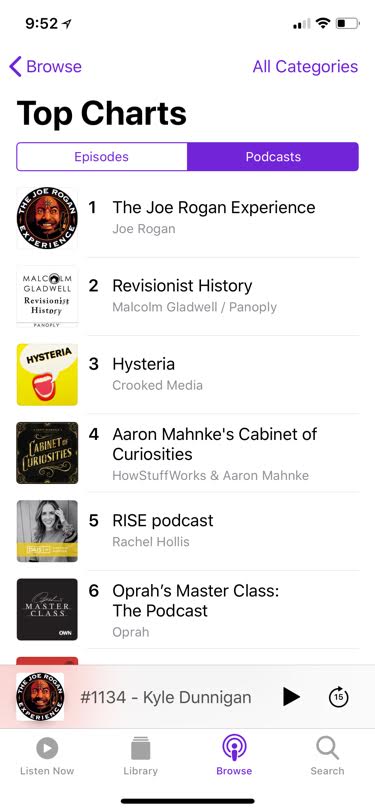
“The Medium is the Message.” – Marshall McLuhan.
Rogan has guests from the cultural zeitgeist, and he discusses current issues so the audience feels like they’re being educated (much the way people would get their news from the Daily show).
But I find his use of the medium the most compelling reason. Here are the factors:
1. LONG SHOWS
In the first episode I ever listened to, I heard Joe say, “This is it people, there’s no editing.” And I was pissed! I thought – Do me the favor. Edit this to the best parts so I can listen in 20 minutes. But now if it’s a good episode I’ll listen to the whole 3 hours. It feels like eavesdropping on a great conversation, as opposed to a lot of sound bites.
2. IN-PERSON
In comparison, Skype/phone podcasts feel really distant, especially if people have bad mics (or no mics).
3. STRONG ENVIRONMENT
Guests don’t go to a room, they got to Joe’s Disneyland – They see the archery range, the float tank, pool table, gym. You’re entering his world, and the guests have a great sense of wonder and respect going into it.
3. PREP TIME WITH GUESTS
While it’s not actual preparation, Joe spends time with them beforehand, talking or playing. So there’s a warm up (which all great athletes do). By the time they’re talking, they’re in the groove, unlike most podcasts, which start cold.
4. COMEDY AND IMPROV
He’s a great comedian, so he can make fun of anything. And he’s also conversing with the principles of improv – he listens really well and can riff on what anyone is saying. So there’s a flow to it. I feel ruined for other podcasts because they feel so rough in comparison. (Here is my own foray into standup comedy)
5. HAVING A LISTENER
This is a bit strange, but in the personal development space, programs like Landmark actually have people whose role it is just to listen. They’re holding space for a larger conversation. The producer “Young Jamie” on Joe’s show listens and brings in relevant information. It gives the show a 3D feeling whereas a two-person show feels flatter (think about it from a sheer physics stand point – It takes 3 points to create a stable plane whereas two points are inherently unstable).
I would recommend checking out the episodes with Jesse Itzler, and Steven Tyler.
One other show that does it well is “Anna Fariss is Unqualified” for many of the same reasons. Check out the episodes with Bert Kreisher and Mayim Bialik.
April 17, 2018
Great cultures
I walked away from what I thought was the best meeting ever…
“Yes, we got everything we asked for!” I said.
We had just walked out of a meeting with Zappos CEO Tony Hsieh, and he gave us all the resources we asked for to launch a new project.
My colleague said, “That’s not good.”
“What?! Why?”
“He didn’t say no to anything. What other support could we have asked for that we didn’t think of?”
Ohhh….
Such an interesting concept.
You don’t know that you’ve asked for too much until someone says “No.”
Many friends and colleagues have offered to help me. I rarely ask for it, but when I do, I get a Yes.
So now I’m wondering: What else is possible? What am I leaving on the table?
What could you be asking for?
It’s amazing how often the response will be a simple, “Yes.”


 Text Robert