Do you have a healthy sense of drama?

August 3, 2012

Values

The word “drama” has gotten such a bad wrap. People say they want less drama in their lives and their relationships, and yet we emotionally crave it.


Just take a look at our fascination with shows like Breaking Bad, Dexter, The Wire, The Sopranos (etc). We want to experience these emotions, but safely from the comfort of our own sofa. But if we don’t have a way to bring that sense of excitement into our own lives (without destroying them), then we will constantly be stuck at home watching TV, and our memories become the shows we’ve watched, instead of real life.


Let’s start with what the word drama means (and by the way, if you ever want to get to the core of a discussion, debate or argument, then start by defining your terms. You would not believe how often people argue about something that they’re not even talking about).


Drama is the sense that anything can happen, and stakes are high.  (read that over a couple times).


Now, notice there is nothing inherently wrong, evil, bad or destructive about this, though it certainly can be. Here is the most basic example of drama and its power to engage: If you walk by a poker room in a casino, all the tables look the same, then you’re not likely to stop and watch.  But if someone says, “I’m all in,” and they move all their chips to the middle, then they have our attention… Anything can happen, and the stakes are high. Suddenly life is interesting.


So how does that become healthy?  Think about it in the context of getting what you want out of life… I wanted to write my own book, so my coach said, “How long do you think it will take to finish it?” I said, “A month.”  But he knew I would procrastinate, so he told me to get out my check book. Then he talked about finding an organization I would never support. We looked online and found a group that clearly supported hate crimes. He had me write a check for $300 to that group and said, “I’m going to take this. If you don’t have your book to me by the end of the month, I’m sending them this check.”  Anything could happen, and stakes were high. I completed my book in less than 3 weeks.


Recently, I felt completely alive on a 500 mile relay bike race that ran over 30 hours straight. We went through thunderstorms, construction zones, and pitch black darkness, all in a race to the finish, struggling just to stay awake. Clearly it was dramatic, but what made it healthy and safe was that I was with an amazing team and we constantly had each other’s backs.


Another example: A friend of mine is the CEO of a start-up and his team was not performing well. He called them together and decided to add a bit of drama… He shared, in full sincerity that he wanted to step down as CEO because he believed he was not the person who could lead and inspire them. To his surprise the team vehemently disagreed. They loved him and believed he was the best CEO, but they had disengaged because they were rebelling. They wanted more time with him, and their lack of performance came out of their feeling resentment. He was re-energized but decided to put both him and them to a test. He said, “Let’s pick one big audacious task for each of us to complete. I will do one as well. If we all complete it by midnight tomorrow, then I’ll know we are all truly engaged and I’ll stay on and move forward.” Anything could happen, and stakes were high.  The team rallied together and all tasks were completed by midnight.


Of course, it could have gone the other way. But that’s why it’s great. Drama brings out what’s really there, and what we’re really committed to.


All of this is a theory I’m working on. It’s clearly not fully thought out. To me it brings up questions like, how much drama do we need? When does it become stressful? What are the catalysts or triggers that bring up the need?  I’d love to hear your thoughts or stories. I believe it may apply to relationships as well. My working hypothesis is that those who consciously create drama, rather than trying to avoid it, tend to be the most successful and happy people.

What do I focus on??? (the 3-point strategy)

July 9, 2012

Uncategorized

“If you have more than 3 priorities, then you have no priorities” – Jim Collins in Good to Great


I have a lot of ideas, and a lot of projects I want to start. And yet, I know that focus is the key. I used to think I could just try a lot of things. You know – throw them up against the wall and see what sticks. But then I realized that’s a way of rationalizing my doing a half-assed job at a lot of things and expecting luck to show up.


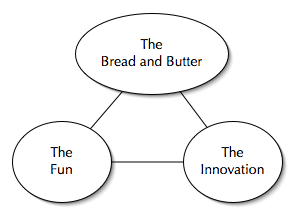
And yet, how can I just focus on one thing? That is so boring. I took a look at what I’m most excited about and what I need, and I came up with the The Three Point Focus Strategy…


Screen_shot_2012-07-09_at_1


1. The Bread and Butter (80% of time)
This is the focus that pays the bills. It’s the area where you have the skills to deliver value to a customer consistently (and that customer may be your employer). You also have the passion to do it, so that you don’t burn out. And lastly, there’s a market for it. This is your top priority because without it, everything will turn to shit, fast.   For me, this is my culture consulting business, and my first book, the Culture Blueprint. If you are having trouble with this as a business, check out Business Model Generation. If you are having trouble with this as an individual (employee or freelancer) then check out Business Model You. If you know what you want, but you’re just having trouble getting a job, check out The Two Hour Job Search.


Now, something to note about the bread and butter. Even with passion, it can often come with challenges. When they come up, I think of this quote:  Opportunity is missed by most people because it comes dressed in overalls and looks like work.” –  Thomas Edison 


2. The Innovation (10% of time)
Your innovation project is the one that you want to work on, but it’s not fully developed yet, or there’s not a market for it. You also may still be developing your skills in this area.  If you’re like me you probably have a lot of these, but the idea here is to pick just one.  For me, that’s an idea called “The Corporate Start-up.” – It’s all about ways for businesses to turn their brand itself into a product, and to turn cost centers into profit centers. It’s not fully developed and I certainly can’t start charging for it, so it’s my innovation project.


3. The Fun (10% of time)
This is for the hare-brained ideas. The ones that make you laugh, the ones that are just ridiculous and yet they would be so much fun. You have absolutely no way of justifying your time on this except that it makes you smile and gives you energy. For me, this is a site called Dating is for Douchebags. It’s all about how the current model of dating is totally flawed, and my ideas to re-invent it. I’m just having fun with it, and inviting others to contribute if they feel the same way.


So there you have it. Select your three to focus on, and give the majority of your time to number 1.

Ideas and Execution

June 24, 2012

Uncategorized

I asked my friend Chance what his best advice would be for me in writing a book. He said, “The best advice I can give you is the one piece you don’t want to hear… JUST WRITE IT… One idea fully executed is worlds better than a thousand great ideas that go nowhere.”


Quickly thereafter I would write 5 pages a day, and then locked myself in for 4 days to do nothing but writing. And now I have a working copy of my thoughts on creating a great place to work, called The Culture Blueprint.


While Chance’s advice was key, here is what I consider to be the leverage point:


Separate your idea versus execution time. 


In other words, consider these as two different people. When you are in a wild storm of ideas, take them all down. But when you execute do NOT let the idea person in the room. That person is not welcome. That person will mess up the process. They have good intentions, but they will derail your inner executer.

The Prescription of the Big Cleanse

March 23, 2012

Uncategorized

Okay, here’s the prescription, as discussed in previous posts.

I recommend first reading Mastin’s original story behind the cleanse (Part 1, Part2, Part 3), and he’s is also available as a mentor through this.

Then here’s the plan. For 30 Days…

ELIMINATE:

  • Sugar
  • Wheat
  • Dairy
  • Alcohol / Drugs
  • Caffeine
  • Sex
  • Dating
  • Flirting
  • Masturbation
  • Facebook
  • TV
  • Talking to Ex’s or Crushes

START:

I have found that myself and others question the Kundalini Yoga part, but it was really quite essential in processing all the emotion that comes up. Mastin did it twice a day on the cleanse so he believes 3x a week is the minimum.

As you can see, it’s no small deal to do this. But two of my friends dived in instantly. One is almost complete and the other just started, and both are loving the experience of really getting into what emotions have been pushed down for years.

Consider it like a re-boot, for your life.